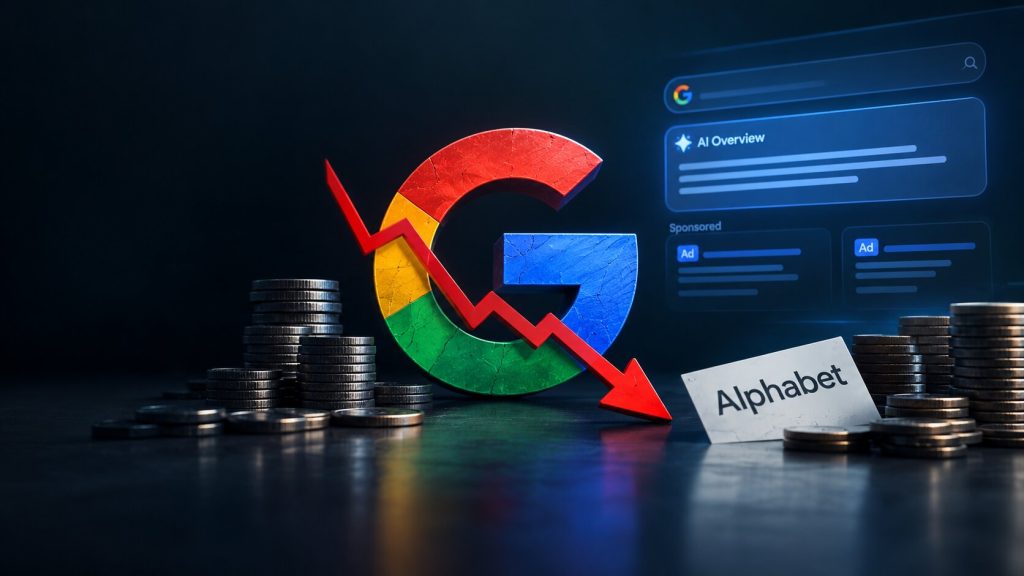
There’s a conversation that happens in almost every company that wants to grow digitally: do we start with Google Ads or with SEO? And it usually ends badly, because the answer depends on variables few agencies explain before you sign the contract.
This guide won’t give you a generic answer. It will give you the framework so that you, with your company and your context, can decide with data.
What each one is (no beating around the bush)
Google Ads is paid advertising. You pay to appear in Google’s top results when someone searches for your product or service. When you stop paying, you disappear. Traffic is immediate, but it has a cost per click.
SEO (search engine optimization) is the work of organic positioning. You optimize your site, build authority, produce content, and Google decides you deserve to appear at the top without paying for each visit. It takes months to deliver results, but the traffic it generates has no direct cost per click.
The confusion comes from the fact that both use Google as a channel. But they are completely different mechanisms.
The real numbers in Colombia
Before getting into the debate, some context for the Colombian market:
- The average CPC (cost per click) on Google Ads in Colombia ranges from COP 800 to 8,000 depending on the sector. Sectors such as insurance, loans or professional services are at the high end.
- A well-executed SEO project can take 4 to 9 months to generate measurable organic traffic.
- Ad campaigns can bring leads from day one if the setup and landing page are right.
- The average CTR of the top 3 organic results on Google is around 28–35% for position 1, 15–20% for position 2 and under 10% for position 3.
None of this tells you what to choose. But it does tell you that time and available budget are two of the most important variables in the equation.
When it makes more sense to start with Google Ads
When you need results within 60 days
If you’re launching a new product, your company was just founded or an important sales season is around the corner, SEO simply won’t arrive in time. Ads are the speed tool.
When you already have a monthly ad budget
Google Ads works with continuous investment. If you don’t have a sustainable monthly ad budget (at least COP 1,500,000–2,000,000 for clicks alone, not counting management), results will be inconsistent.
When your product has active search demand
If your customers search Google for what you sell (“pest control company Medellín”, “labor lawyer Bogotá”, “corporate uniform supplier”), ads capture that existing demand immediately.
When you need to validate which keywords convert
This is less obvious but very valuable: running ads for 2–3 months gives you real data on which keywords bring leads and which generate clicks without conversions. That learning then feeds your SEO strategy.
When it makes more sense to start with SEO
When you have an investment horizon of 12+ months
SEO is a long-term bet. If you can invest consistently for a year without expecting an immediate return, the asset you build (organic rankings) keeps generating traffic even if you stop paying at some point.
When your industry’s CPC is unsustainable
In sectors where clicks cost COP 5,000–15,000 (lawyers, insurance, loans, healthcare), the cost of acquisition through ads can exceed the business’s margin. SEO, though slow, may be the only profitable lever.
When your business model lives on educational content
Consultancies, B2B service firms, technology companies, agencies: if your ICP searches for information before buying (“how to reduce payroll costs”, “what is a tax audit”), SEO captures that intent with content that converts in the medium term.
When you already have some organic traffic and want to scale it
If Google Search Console already shows you impressions and clicks on some keywords, you’re one step away from multiplying them with well-executed SEO.
Why the real question isn’t “which” but “in what order”
Here’s the insight few agencies tell you at the first meeting: Google Ads and SEO don’t compete; they complement each other.
The problem is that Colombian companies rarely have an unlimited budget, so you do have to prioritize. And the right priority depends on three variables:
- Speed needed: how long can you wait for results?
- Available budget: can you sustain monthly ads without choking your cash flow?
- Business stage: are you validating, scaling or consolidating?
| Stage | Recommendation |
|---|---|
| Startup or new company | Ads to generate demand and validate. SEO in parallel if resources allow. |
| Growing company (1–5 years) | Ads for short-term opportunities. SEO as a long-term investment. |
| Established company | SEO as the main engine. Ads for seasons and specific keywords. |
| New product launch | Ads first, always. |
| Sector with very high CPC | SEO first. Ads only for the highest-converting keywords. |
The most common mistakes in this decision
Mistake 1: Abandoning SEO because “it takes too long”. The companies that dominate Google organically today started 3 or 4 years ago. Those that started SEO last year are already seeing results. Those still waiting for the “ideal moment” haven’t moved forward.
Mistake 2: Running ads without an optimized landing page. 60% of the ad campaigns we inherit from other providers have the same problem: a good budget, good clicks and a landing page that doesn’t convert. The problem isn’t ads; it’s the whole chain.
Mistake 3: Doing content SEO without a technical foundation. Publishing articles on a slow website, with a broken structure or indexing problems, is like sowing in unplowed ground. Technical foundation first, then content.
Mistake 4: Believing position 1 in ads = position 1 organically. They’re different spaces on the results page. Users know how to tell them apart. The organic CTR of position 1 far exceeds the CTR of the ad in position 1 in most categories.
Real cases: what works in the Colombian market
At Gulupa Digital we’ve executed both strategies in very different sectors. Two illustrative examples:
A B2B industrial services company: we started with ads for the first 4 months to generate leads while SEO matured. After 8 months, organic traffic began to exceed ad traffic. Today they run ads only for seasonal campaigns, and SEO carries 70% of their digital leads.
A fashion e-commerce business: CPC in fashion is low and organic competition is extremely high. We recommended ads as the primary channel, with SEO focused on specific product categories. The combination resulted in 40% more sales in the third month compared with the first month of execution.
There’s no universal formula. There’s a diagnostic process that should be the starting point.
Frequently asked questions
Can I do Google Ads and SEO at the same time?
Yes, and in many cases it’s the optimal strategy. Ads generate immediate traffic and conversion data; SEO builds the long-term asset. The challenge is the budget: it requires simultaneous investment in two channels.
How long does SEO take to deliver results in Colombia?
Between 4 and 9 months to see significant movement on competitive keywords. For long-tail keywords or less competitive niches, it can be 2–4 months. It depends on the site’s technical condition, domain authority and the competition.
Do Google Ads affect organic rankings?
Not directly. Google has confirmed that paying for ads doesn’t improve organic rankings. They’re separate systems. However, ads can increase overall traffic to the site, and if that traffic generates good signals (time on page, navigation), it can have an indirect influence.
What happens if I stop paying for Google Ads?
Traffic stops immediately. There’s no “inertia” as there is with SEO. That’s why it’s important not to build 100% of your digital strategy on ads.
What minimum budget do I need for Google Ads in Colombia?
For a campaign to have enough data to optimize, we recommend at least COP 1,500,000–2,000,000 a month in click spend alone. Below that threshold, the campaign doesn’t have enough volume to learn and improve.
What’s better for local SEO in Colombia: content or backlinks?
Both are necessary, but the sequence matters. Without a solid technical foundation and relevant content, backlinks have nowhere to “land”. The right sequence: technical foundation → optimized content → building authority (backlinks).
What you should do today
If after reading this you still aren’t sure which to prioritize, the most honest answer is: you need a diagnosis of your specific situation before deciding.
A real diagnosis evaluates your site’s technical condition, the search volume of your keywords, the organic and paid competition in your sector and your monthly investment capacity. With that on the table, the decision becomes much easier.
If you’re going to run one of the two, here are our services: Google Ads advertising and SEO.
Talk to a Gulupa Digital strategist → contact us