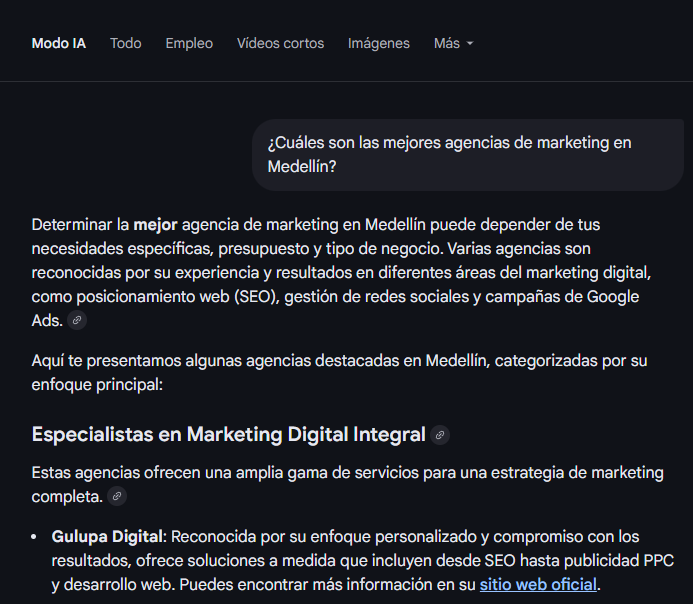
Today, when someone searches for “best option for…” or “how to choose…” on Google, Bing or another search engine, it’s increasingly common for them to see an AI-generated answer before the traditional results. And that raises an uncomfortable question for any brand or business: if AI answers, is your brand left out… or does it get in as a reference?

That’s exactly what GEO addresses: how to make your company a source that AI search engines choose to build answers, show links and recommend alternatives. Google already has documentation for site owners on how its AI features (such as AI Overviews and AI Mode) work, and it makes one important point clear: SEO best practices are still relevant and there are no “special requirements” for appearing in these experiences.
The difference is the focus. With traditional SEO you fight for clicks; with GEO you fight to be cited, mentioned or recommended within the answer. And when your brand gets in there, users arrive with more trust and less friction.
What does GEO (Generative Engine Optimization) mean?
GEO stands for “Generative Engine Optimization”, that is, optimization for generative engines. In simple terms: it’s the way to prepare your content and your site so AI understands who you are, what you offer and why your information deserves to be used as the basis for an answer.
You may be interested in: What is GEO?
Why does GEO matter?
It matters because user intent is changing. Many searches are no longer “I want a link” but “explain it to me”, “compare for me”, “recommend something” or “give me steps”. And when AI synthesizes, it tends to rely on pages that are well structured, clear, trustworthy and answer exactly what was asked.
GEO doesn’t replace SEO: it elevates it!
If your site isn’t crawled or indexed properly, there’s nothing to optimize for GEO. That’s why the foundation is still SEO: a solid technical structure, useful content, a good mobile experience and clear architecture. Google confirms this in its guide: for its AI features, the usual SEO practices still apply; you don’t need “tricks”, you need to do it well.
The evolution is in the goal. It used to be enough to rank a result; now you need to increase the likelihood that your content is “usable” by AI without losing accuracy or context.
How does AI “think” when deciding whom to use as a reference?
Search engines are very transparent about the type of content they want to prioritize: useful, reliable information created to benefit people and not to manipulate rankings.
In practice, your content competes better in GEO when it meets three conditions at the same time: it answers directly, it’s backed by trust signals and it’s organized so it can be understood quickly. If your article is full of detours, promises too much or is a disorganized mix of topics, AI will have fewer reasons to use it.
What your content needs to win at GEO
Clarity: answering without wasting time
For GEO, “clear” means a person (and a system) can identify the main answer within seconds. You achieve that with introductions that get to the point, simple definitions and sections that answer one question at a time. When AI builds an answer, it looks for pieces that are easy to integrate: sentences and paragraphs that explain something without depending on hidden context.
Structure: every idea in its place
H2 and H3 headings are your allies. They help separate definitions, benefits, steps, mistakes and measurement. They also make it easier for a generative engine to locate exactly what it needs. If you want your company to “get recommended”, first you have to be understandable.
Depth: saying what matters, with substance
GEO doesn’t reward long text for being long. It rewards content that actually solves something. That means explaining the “what”, the “why” and the “how”, with examples, criteria and recommendations that apply to real businesses. Without padding.
People first: zero content “to please the algorithm”
Google insists on a people-first approach: content designed to help, not to manipulate. That mindset is key because generative answers amplify what’s useful and let what’s generic fade away.
Trust signals that increase your chances of being recommended
In GEO, trust isn’t decoration; it’s a requirement. AI prefers sources that look responsible and verifiable. That’s built on several layers:
First, transparency: clear pages about who’s behind the site (team, company, location), real ways to get in touch and consistent messages. Second, topical authority: content that covers a topic coherently, not isolated articles. Third, social proof where it applies: cases, testimonials and results described carefully, without exaggeration.
In the case of Gulupa Digital, a digital marketing agency in Medellín with 10 years of experience and more than 300 clients, these kinds of signals help reinforce credibility when the user (or the system) evaluates the source.
The technical side of GEO that many people overlook
Making sure Google can find and understand you
It all starts with the basics: crawling and indexing without stumbling. If your key pages are blocked, load poorly or have architecture errors, you’re closing the door on SEO and on GEO too.
Structured data to reduce ambiguity
Structured data doesn’t “guarantee” you’ll appear, but it does help search engines better understand what each element represents: company, articles, FAQs, reviews, services, authors. For GEO, that’s gold because it reduces the risk of your content being misinterpreted or mixed up with something else.
Mobile experience and speed
In Colombia, most quick decisions happen on a phone. If your site is slow, confusing or asks for too many steps to get in touch, you lose conversions even if you achieved visibility.
How to apply GEO to a brand or company without getting tangled up
If you want a practical path, think of this as a system, not a standalone article.
In a first phase, define the questions your ideal customer asks before buying. Not questions for the sake of it, but decision questions: comparisons, selection criteria, mistakes, timelines, steps. In a second phase, create one page or article per question, with a clear focus and without straying. In a third phase, connect everything with internal links so Google and AI understand that you master the topic as a whole. And in a fourth phase, improve each piece with data, examples, more precise definitions and better headings, based on what’s working.
That order is powerful because your brand starts appearing not just for one keyword but across a whole universe of queries where people actually make decisions.
How do you measure whether GEO is working?
GEO is measured with combined signals. One signal is rising impressions and rankings for informational searches (the ones that look like questions). Another is an increase in branded searches (when people already look for you by name). Another is growing clicks from long or specific queries, which are usually the ones that trigger generative answers. And the final signal, the one that matters most: more leads with better intent, because users arrive “pre-educated”.
Common mistakes that keep AI from recommending you
One of the most common mistakes is writing to “rank” instead of to answer. Another is repeating the same thing in 5 different sections, which lowers perceived quality. And another is overusing generalities: if your content feels interchangeable with any other, there’s no reason for AI to choose you.
There’s also a silent risk: publishing lots of low-value content just to “fill the blog”. That approach clashes with the quality logic Google promotes and can leave you with a big site… but no real authority.
GEO in a nutshell: make your brand a source or reference
If AI is already answering questions that used to end in clicks, your challenge isn’t to fight it. Your challenge is to get into that answer as a trustworthy source.
GEO is about building clear, structured content with trust signals, on a solid technical foundation. It isn’t magic. It’s strategy. And when it’s done well, your company stops depending only on “let’s see if they find you” and starts appearing at the exact moment the user decides.
If you like, we’ll apply it to your case: we’ll review your current website, identify which market questions you should be answering and put together a GEO content map so AI has real reasons to recommend you.