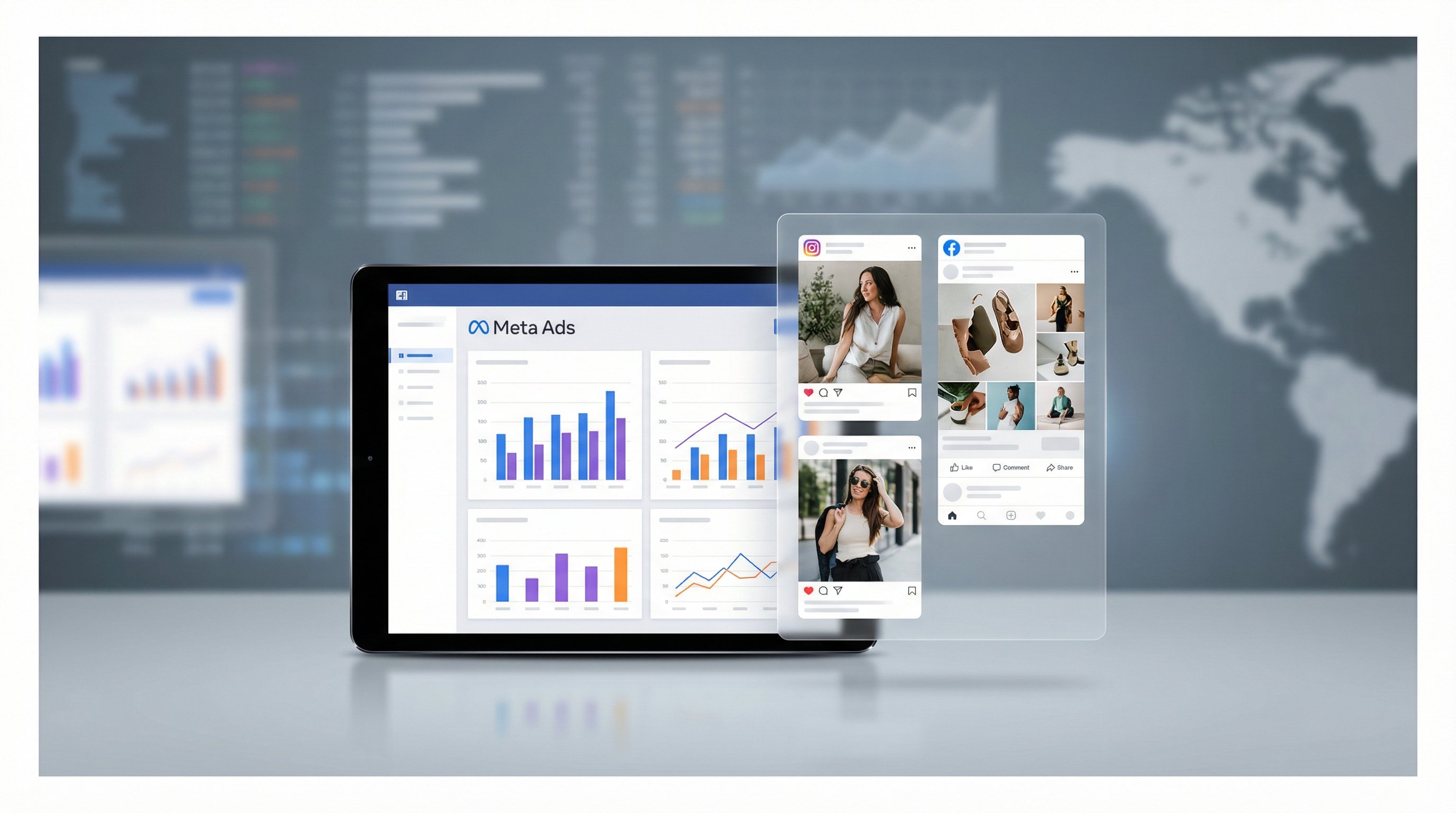
The Meta Ads playbook that worked in 2021 no longer applies. The platform’s rules have changed, competition has increased, costs have gone up and Colombian users behave differently on Facebook and Instagram than they did three years ago.
Some companies keep using the same tactics from that playbook and wonder why their ROI has dropped. And some companies have updated their approach and are generating more leads with less investment than before.
This article tells you where the difference lies.
The real state of Meta Ads in Colombia today
Meta (Facebook and Instagram) is still the digital advertising channel with the widest demographic reach in Colombia. With more than 22 million active users on Facebook and around 16 million on Instagram, the audience is there.
The problem isn’t reach. It’s that CPM (cost per thousand impressions) in Colombia rose by 30% to 60% between 2021 and 2024, depending on the sector. And competition in the auction is significantly greater.
What that means in practice: the same budget as 3 years ago reaches fewer people, under more competitive pressure. And generic creatives, which used to convert because the channel was less mature, no longer work.
What happens when you combine Meta with good tracking
Meta Ads improves a lot when it stops living only in Ads Manager and starts connecting with the CRM, email, remarketing and sales. Then it’s no longer about “a lead came in” but about how warm it arrives and at which step it drops off.
That combination lets you refine the strategy. You can see which campaign brings better contacts, which content feeds more interest and which audience responds best to the second or third touch.
For Colombian companies, that reading is worth more than a pretty campaign. Because the business doesn’t get paid for views; it gets paid for opportunities that move forward.
If your campaigns aren’t connected to real tracking, you’re missing half the story. And that half is usually the most important.
When Meta Ads really moves the needle
Meta Ads is still very useful when you need to generate demand, educate the market or re-engage people who have already shown interest. If you sell a service that requires context, explanation or trust, the channel can do a lot of work before the first contact.
It also works well when you have a good first-party database. With lookalike audiences, remarketing and content sequences, the system stops firing ads into the air and starts working with more useful signals.
For Colombian companies, Meta usually performs very well when the funnel is designed for it: content at the top, social proof in the middle and closing via a form, WhatsApp or a landing page.
If your brand doesn’t have an organized funnel yet, Meta Ads can help, but not by magic. It needs structure.
What’s working best in the market
Short video, clear messages and creatives that look human. Users have learned to ignore corporate banners that smell of stock photos and templates. Today clarity counts for more than decoration.
The best ads usually open with a real pain point, a concrete figure or a specific promise. No endless detours. If within the first few seconds it isn’t clear why it should matter to them, the scroll wins.
Another piece that works very well is content that educates before asking. A useful video, a carousel with a lesson or a piece with a real case builds more valuable remarketing audiences.
Review your creatives as if you were your ideal client. If they don’t stop the scroll, they aren’t doing their job.
When Meta Ads becomes a money-burning machine
When it’s used as a substitute for strategy. If you put budget into a campaign without a clear goal, without tracking and without a landing page or form that converts, the system only helps you spend faster.
It also becomes fragile when there isn’t enough volume to learn. Tiny budgets, changes every three days and open targeting without control mean the algorithm never manages to stabilize.
Another serious mistake is measuring only clicks or reach. It’s nice to see big numbers, but if they don’t translate into leads, the business stays the same. Or worse: it thinks things are going well.
If your campaign is full of clicks but empty of opportunities, the problem isn’t the ad. It’s the whole structure.
What a serious campaign checks before scaling
First, the message. Does it speak to the right pain point? Does it say something concrete? Does it promise a realistic result? Second, the audience. Is it based on first-party data, behavior or overly generic interests? Third, conversion. Is there a clear action at the end?
Then comes tracking. Without the pixel, the Conversions API and properly configured events, you don’t know what’s really happening. Meta feeds on signals. If you give it bad signals, it optimizes badly.
That’s why a good campaign isn’t only looked at in Ads Manager. It’s also looked at on the website, in the CRM and in the business. That triangulation is what lets you decide with judgment.
If you’re going to scale Meta, first confirm that your measurement holds up. If not, growth can turn out very expensive.
How to keep your audience from burning out
Some companies feel that Meta “broke”, but in reality they burned out their audience. They showed it the same message too many times, without varying the angle or moving the journey forward. Users don’t hate the brand: they just got tired of the ad.
The way out isn’t publishing more of the same. It’s rotating creatives, changing formats, adjusting the message and moving users through stages. The same audience can see an educational video, then a real case and then a specific offer without becoming saturated.
That kind of sequence works better than a flat campaign that keeps pushing the same design for weeks. People don’t buy through endless repetition; they buy when the message moves forward.
If you feel your audience is tired, don’t kill the campaign straight away. Change the message before blaming the channel.
What no longer works
Static creatives with a low design budget
The Instagram and Facebook feed is saturated with images with overlaid text and corporate colors. Users ignore them in 0.3 seconds. The platform also penalizes them with lower reach and a higher CPM.
Broad interest audiences without refinement
“People interested in digital marketing in Colombia” was a targeting option that worked when the platform had more precise data. Today, after the iOS 14 changes and privacy restrictions, those audiences are less precise and more expensive.
Traffic campaigns to a website without a configured pixel
If your campaign sends traffic to a website where the Meta pixel isn’t correctly configured, the platform can’t optimize for conversion. You’re paying for clicks without any data learning.
Generic CTAs (“Visit us”, “Learn more”, “Buy now”)
The CTR of these CTAs in the Colombian market has consistently dropped. Users need to know exactly what will happen and why it’s worth clicking now.
What does work today
Short video with a hook in the first 3 seconds
Video is still the format with the best CPM on Meta. But attention is decided in the first 3 seconds. Videos that open with a direct question about the user’s pain (“Does your company generate leads but none of them close?”), a provocative statement or a surprising figure have significantly higher view rates.
For the Colombian B2B market, videos of 30 to 90 seconds work well. For B2C with a visual product, 15–30 seconds.
Lookalike audiences based on real clients
If you have a list of your best clients (at least 300–500 contacts), Meta can build an audience of people with a similar profile. In Colombia, a well-configured lookalike has conversion rates 2x to 4x higher than cold interest audiences.
Meta’s native forms (Lead Ads) for B2B
For services with a long sales cycle (agencies, consultancies, industrial services, specialized healthcare), Meta’s native forms have significantly higher conversion rates than sending traffic to an external landing page. The form is pre-filled with profile data and reduces friction.
The cost per lead in Colombia with well-configured Lead Ads can be between COP 8,000 and 30,000, depending on the sector.
Content that educates before selling
Value-content campaigns (articles, guides, educational videos) at the top of the funnel build high-quality remarketing audiences. A user who has consumed 3 pieces of your content before seeing a bottom-of-funnel ad has a much higher conversion rate than one who sees the ad for the first time.
Remarketing segmented by behavior
Not every user who visited your site deserves the same ad. Someone who visited the pricing page is at a different moment from someone who read a blog post. Remarketing audiences segmented by page visited or time on page have significantly lower CPAs (costs per acquisition).
The most frequent Meta Ads mistakes in Colombia
Mistake 1: Pausing campaigns before the algorithm learns. Meta needs around 50 conversions a week in a campaign for the algorithm to exit the learning phase and stabilize. If you pause or make big changes in the first 7–14 days, learning restarts and costs go up.
Mistake 2: Using only one ad per ad set. Accounts that test 3–5 creative variations at the same time consistently perform better than those running a single ad. The platform optimizes toward the one that works best; for that it needs options.
Mistake 3: Not connecting ads with conversion tracking. If you don’t know how many real leads each campaign generated (not clicks, but verified conversions), you can’t optimize. A properly configured Meta pixel and the Conversions API are mandatory for any serious campaign.
Mistake 4: Budgets below the learning threshold. A budget of COP 300,000 a month on Meta Ads isn’t enough to generate learning data in any sector. The platform needs volume to optimize. Below COP 1,000,000–1,500,000 a month in spend, results are very inconsistent.
Frequently asked questions
How much should you invest in Meta Ads in Colombia to see results?
For the platform to have enough volume to optimize, we recommend at least COP 1,000,000–1,500,000 a month in media spend alone. On top of that comes the agency’s or provider’s management fee. Below that threshold, results are inconsistent.
Does Meta Ads work for B2B companies in Colombia?
Yes, but it requires a longer funnel strategy. Content + remarketing + Lead Ads campaigns work well for professional services, consulting, software and industrial services. The conversion cycle is longer than in B2C, but lead quality can be higher.
Meta Ads or Google Ads for a company in Colombia?
It depends on purchase intent. Google Ads captures existing demand (users are already searching for what you sell). Meta Ads generates demand (it shows your product to people who weren’t looking for you). For many companies, combining both platforms is optimal.
How precise is Meta’s targeting in Colombia?
Less precise than 3–4 years ago, after the iOS 14 privacy changes. Interest audiences are noisier. That’s why lookalikes based on first-party data (real clients, site visitors) work better than cold interest audiences.
Which format usually performs best?
Short video and carousels usually perform very well when the message is well built. The key is the first second, not the decoration.
Do I need a landing page for Meta Ads?
Not always, but you do need a clear conversion path. It can be a native form, WhatsApp or a landing page; what matters is that the action is easy and measurable.
Does Meta Ads work for B2B?
Yes, especially in the consideration, remarketing and trust-building phases. It doesn’t always close in one go, but it can move the decision a great deal.
How do I know if I’m burning out my audience?
If frequency goes up, CTR goes down and cost per result gets worse, you’re already seeing signs of saturation.
How many ads should I test?
There’s no magic number, but it’s worth having several variations of message or format so the learning is real.
When should I pause a campaign?
When the creative is exhausted, conversion falls and there are no more useful changes to test without rebuilding the piece.
The next step
If you’re investing in Meta Ads without seeing a clear return, the problem usually isn’t the platform: it’s the strategy, the creative or the technical setup.
See our social media advertising service → social media management