How much money are you throwing away by choosing the wrong “page”?
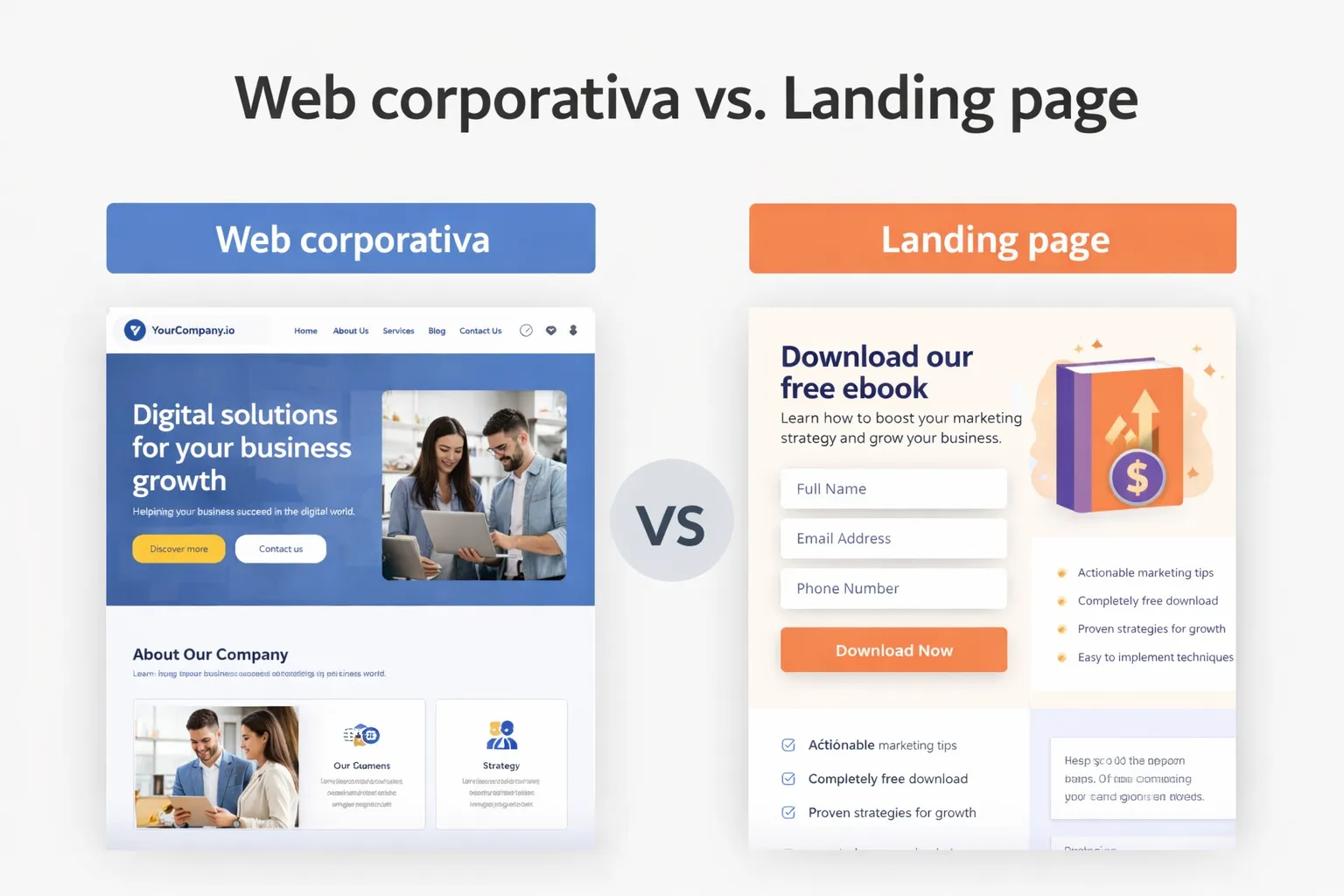
We see it all the time: companies that build a landing page hoping to “look serious” and end up with a funnel that inspires no trust. Or companies that spend months building a gigantic corporate website for a 15-day campaign… and the ad ends up sending people to a section with a menu, 12 options and zero conversion.
The decision isn’t aesthetic. It’s operational: what you want to happen after the click and how you’ll measure it.
If you only read one part, make it this:
- If you’re going to run ads for a specific offer (book/get a quote/buy): a landing page.
- If you want SEO, trust and sales support (long-cycle B2B): a corporate website.
- If you sell something complex: a landing page to capture + a website to back it up.
The real question: what do you want to happen after the click?
If your answer is “for them to contact me”, there’s still a piece missing: why they should contact you and how prepared you are to receive that contact.
A corporate website works when you need to build trust, explain clearly what you do, demonstrate experience and make it clear why your company is a good decision.
A landing page works when you want the person to do one specific thing, without getting distracted.
Let’s set business goals — the kind you feel in the cash register:
- You want qualified prospects for a specific service (B2B). Expected result: forms with useful information, not “hi, info please”.
- You want to validate a new offer (or a new segment). Expected result: fast data, not a perfect website.
- You want to sell something with a clear flow (book, quote, buy). Expected result: measurable conversion.
- You want to rank on Google for several intents (SEO). Expected result: sustained organic traffic and authority.
If your goal sounds more like “brand” and “trust”, you’re heading toward a corporate website. If it sounds more like “conversion” and “one action”, you’re heading toward a landing page.
If your traffic arrives through ads or campaigns and you don’t know which page to use, write to us and we’ll give you a recommendation based on your goal (no smoke).
The difference between a website and a landing page (no nonsense)
The question “what’s the difference between a website and a landing page?” usually turns into a debate about definitions. In real life, the difference is about behavior and measurement.
A direct answer (so your team stops arguing about definitions):
- Corporate website: several pages + navigation + supporting content (services, cases, blog). Its job is to build trust and sustain SEO and sales.
- Landing page: one page + one offer + one action. Its job is to convert and measure.
A corporate website is an ecosystem. It has several pages, menus, routes, content for different types of people and, if it’s done well, a structure designed for SEO and sales.
A landing page is a stage. You arrive, understand, trust, act. No detours.
Here’s the comparison that really matters:
| Dimension | Corporate website | Landing page |
|---|---|---|
| Main goal | Trust + clarity + rankings + sales support | Conversion to one action (lead/booking/sale) |
| Navigation | Menu, multiple routes, exploration | Limited navigation or no menu |
| Content | Deep and distributed (services, cases, blog, team, etc.) | Focused on a single offer |
| Typical traffic | Organic (SEO), referrals, branded searches, social | Paid media (Meta/Google), email, influencers, QR codes |
| Measurement | Many routes and events; requires good analytics | Easy to measure; ideal for A/B tests |
| Lifespan | Long (months/years) | Short or cyclical (campaigns) |
Two practical consequences:
1) SEO: if your big bet is to appear on Google for several searches, a landing page on its own falls short. Google needs structure, internal links, context and authority signals.
2) Paid media: if you’re paying per click, sending traffic to a corporate website with a thousand exits can get expensive. A landing page lets you control the path.
A recommended source (to ground it in UX, not opinion): the Nielsen Norman Group often explains well why users get lost when a site has too many options compared with a single action.
If you already have a website and want more conversions from it (without rebuilding everything), we can propose a strategy of campaign landing pages connected to your site: lead generation.
When to use a landing page (and when it saves your campaign)
If you’re wondering when to use a landing page, think about this: every click you buy or push with urgency needs a short path.
Cases where the landing page wins by a landslide:
1) Google Ads or Meta Ads campaigns
Google explains it from its own quality logic: the landing page experience influences an ad’s performance and the cost per result. If you want to check the official reference, start with the Google Ads Help Center.
With ads, the user arrives with little patience and lots of comparison. A well-built landing page keeps the ad’s message, reduces doubts and converts better.
If you’re investing in paid media and have no traceability (conversions, events, lead quality), you’re relying on luck. With a landing page + measurement, you take control.
2) Launching a new service
A corporate website tries to cover your whole company. For a launch, that’s noise.
A landing page lets you validate the promise, objections, price and the type of lead that arrives. If it doesn’t work, you adjust quickly without tearing down your site.
3) Capturing leads for a single segment
“I need business clients for X.” Perfect. A landing page with a message for that segment, with proof (cases, logos, figures) and a form that filters.
4) Time-limited promotions (events, limited places, seasons)
When there’s real urgency (a date, capacity, a season), a landing page is the cleanest format for pushing an action.
5) Remarketing (when they see you again)
If someone has already seen you, they’ve already compared. In remarketing, a more direct message works: “book”, “get a quote”, “download”, “talk to a strategist”. Landing page.
6) Products or bundles with a clear promise
If you sell something with a single promise (a plan, a packaged service, a consultation), a landing page lets you tell the whole story without scattering.
7) Collecting useful data (not just “name and phone number”)
Well-made landing pages don’t just “ask for data”: they filter. You can ask about budget, city, type of company and urgency, so your sales team stops wasting time. See also how to reduce friction in lead capture forms.
If any of these scenarios describes your situation, a landing page saves you time and improves conversion. If you’re thinking of “one page for everything”, get ready for “nothing converts”.
If you want a landing page designed for conversion and measurement (not a pretty template), write to us and we’ll plan it with you.
When to use a corporate website (because your company needs serious trust)
A landing page can convert, but it doesn’t replace the role of a corporate website when your sale needs trust, context and consistency.
Scenarios where a corporate website becomes the center of your digital operation:
You have more than one service (and each one raises different questions)
If you offer 4 or 5 services, a landing page becomes an impossible puzzle. A corporate website lets you dedicate a page to each service, with its own message, proof and CTA.
People search for you on Google (and you want them to keep doing so)
SEO is cumulative. You publish content, improve pages, strengthen authority and gain visibility over time.
At Gulupa, when we work on SEO, we don’t think about “a post”; we think about architecture: clear service pages, a blog, internal linking and measurement. If you want that, start with a well-built corporate website.
If you want that to translate into a system (technical + content + measurement), this is the service: SEO positioning.
You sell to companies that compare (B2B)
A business decision-maker doesn’t just fill in a form. They look at references, review experience, look for signs of seriousness and assess risk.
A corporate website lets you show cases, methodology, team, certifications, processes and clear answers. For institutional and high-impact clients (like those Gulupa has served: the Medellín Botanical Garden, the Archdiocese of Medellín, the Universidad de Antioquia), trust isn’t a detail: it’s the filter.
You need operational control (and not to depend on “the person who knows”)
A self-managed corporate website, with properly configured analytics and events, makes everything measurable. If the salesperson changes, the community manager leaves or the agency rotates… the asset keeps working.
If your company is already selling and you need a website that supports growth, see our professional web design service.
A decision matrix: choose according to your goal (without guessing)
The most honest comparison is by business goal. Use this matrix as a quick decision rule.
| Business goal | Best option | Why |
|---|---|---|
| Getting leads for a specific service from ads | Landing page | A single message + easy measurement + fewer distractions |
| Ranking on Google for several searches (SEO) | Corporate website | Long-term structure, content and authority |
| Validating a new offer in 2–4 weeks | Landing page | You adjust quickly without rebuilding the site |
| Improving trust for B2B sales (long cycle) | Corporate website | Proof, cases, methodology, team, support pages |
| Booking meetings with decision-makers | Landing page (backed by a website) | A direct CTA + a supporting page for research |
| Showing a broad portfolio, locations, business lines | Corporate website | Clear navigation and hierarchy |
| A seasonal campaign (high urgency) | Landing page | A short route + a message aligned with the date |
| Repositioning the brand or updating “how you look” | Corporate website | Brand coherence and a complete experience |
If you’re still unsure, check this mini decision tree:
- If traffic arrives through ads and your CTA is “book/get a quote/buy”, prioritize a landing page.
- If your traffic arrives through Google searches and people ask “who are you?”, prioritize a corporate website.
- If you sell something complex, use both: a landing page to capture, a website to back it up.
If you want us to apply it to your case (with a goal, a KPI and a conversion route), book a call.
A scoring matrix (for when there’s a tie)
If your team is divided, use this scoring. Add it up and decide without drama:
| Criterion | If the answer is “yes” | Counts toward | Why |
|---|---|---|---|
| Will you send traffic from ads or an urgent campaign? | Yes | Landing page | A short route, fewer distractions, clear measurement |
| Does your company sell several services or business lines? | Yes | Corporate website | Each service needs its own page and narrative |
| Do you want to rank for several Google searches within 3–12 months? | Yes | Corporate website | SEO needs structure and internal linking |
| Is your CTA a single action (book/get a quote/download/buy)? | Yes | Landing page | One offer, one action, less friction |
| Is your sale B2B, and will the decision-maker research you before talking? | Yes | Corporate website | Cases, methodology, team, trust signals |
| Do you need to validate an offer quickly (2–4 weeks)? | Yes | Landing page | You iterate fast without rebuilding the site |
A practical rule: if the landing page and the website tie, choose both (a landing page to capture + a website to back it up).
Landing page vs. website cost: what really defines the investment
Searches comparing the cost of a landing page and a website usually come with an expectation: “landing page = cheap, website = expensive”. Sometimes that’s true. Sometimes it’s a disaster.
The real cost is defined by this:
- Copy (the message): if your offer isn’t clear, design won’t save it.
- Design and UX: if the user doesn’t understand within 5 seconds, they bounce.
- Development: speed, responsiveness, compatibility, accessibility.
- Integrations: CRM, WhatsApp, calendars, payment gateways, automations.
- Measurement: events, conversions, pixels, Tag Manager, lead quality.
- Testing: adjustments, A/B testing, iteration.
A practical fact: there are “cheap” landing pages that turn out very expensive because they end up being rewritten 3 times, changing the form every week and guessing with the ads. Without measurement, everything becomes opinion.
To give you a reference point without selling you a price list:
- At Gulupa Digital, a professional (VIP) corporate website starts from COP 4,990,000, and the final investment depends on the scope, number of sections, integrations, copy and level of customization.
- A well-made, measurable campaign landing page usually requires less scope than a complete corporate site, but the cost can rise considerably when it needs strong copy, several versions, integrations, automations and continuous optimization.
A quick orientation for budgeting (without selling you a “fixed price”):
- A validation landing page (one offer + form + basic measurement): ideal for validating quickly; it usually costs a fraction of a corporate website.
- A performance landing page (polished copy + objections + events + integrations + iteration): ideal for serious paid media; it can approach the cost of a website, because what’s expensive isn’t “the page” but the conversion system.
- A “complete” corporate website (services, cases, blog, technical SEO, analytics, brand experience): ideal when your company is already selling and needs an asset that holds up. See how much a website costs in Colombia.
The expensive mistake isn’t paying “too much”. The expensive mistake is paying for something that doesn’t serve the goal.
A quick example:
- If you’re going to spend COP 3,000,000 a month on ads and your landing page doesn’t measure conversions, the “savings” of making it cheap get lost in waste.
- If your sales team receives bad leads because the form doesn’t filter, the cost is in hours and lost opportunities.
A tip: if your landing page will integrate with a CRM, WhatsApp, a calendar or automations, see this too (because that’s usually where the “hidden cost” lies): custom web development.
The combination that works best: a corporate website + campaign landing pages
In companies that are already growing, the best move is usually this:
- The corporate website as the “home”: brand, authority, SEO, sales support.
- Landing pages as “doors”: one for each campaign, segment or offer.
That way you stay in control. Each campaign has its own focused page (with its own KPI), and your company has a robust asset that builds trust and rankings.
At Gulupa, this combination becomes powerful when you add measurement and optimization: you see which channel brings quality leads, which message works and where users drop off. You stop arguing about opinions and start deciding with data.
If you’re looking for a complete acquisition system (paid media + landing page + measurement + optimization), this is the service: lead generation.
A quick checklist before asking for “a page” (so you don’t lose months)
This checklist saves you from the typical story: “it’s ready, but nobody comes” or “they come, but they don’t buy”.
- A single goal per page: exactly which action should happen.
- A defined traffic source: SEO, ads, referrals, social media, email.
- A clear offer: what you sell, to whom and what result you promise.
- Social proof: cases, testimonials, logos, figures, processes.
- Measurement in place: events, conversion, forms, lead source.
- Sales follow-up: who responds, how quickly and with what script.
If you’re missing two or three points, that’s normal. It would be strange to have it perfect without a team.
Quick answers for deciding (and for ending your team’s argument)
If your internal WhatsApp group is at war over “corporate website vs. landing page”, copy and paste this:
- If you’re going to advertise a specific service, use a landing page.
- If you sell several services and people compare you on trust, use a corporate website.
- If you want serious SEO, build a corporate website (and then landing pages for campaigns).
- If your goal is to book meetings, a landing page with a direct CTA and a website to back it up.
- If you have little time and need data quickly, a landing page.
- If your brand looks improvised, a corporate website.
The right page reduces commercial friction. The wrong page multiplies it.
Frequently asked questions
Which is better: a corporate website or a landing page?
The short answer: a landing page for conversion in campaigns; a corporate website for trust, SEO and sales support. If you sell something complex, you usually need both.
What’s the difference between a website and a landing page?
The short answer: a website has multiple pages and goals; a landing page has a single offer and a single action.
When should you use a landing page instead of a complete website?
The short answer: when you have a campaign, a specific offer or a quick validation and want a specific action (lead/booking/sale) with clear measurement and no distractions.
Can you do SEO with a landing page?
The short answer: yes, a landing page can rank, but sustainable SEO almost always needs structure + related content + internal links, and that lives better on a corporate website.
What does a landing page usually cost compared with a website in Colombia?
The short answer: a landing page usually costs less because it has a smaller scope, but the investment changes depending on copy, design, integrations and measurement. At Gulupa, a professional corporate website starts from COP 4,990,000.
Does it make sense to have a corporate website and a landing page at the same time?
The short answer: yes. The website builds trust and SEO; landing pages convert better in campaigns. With measurement, that combination usually improves ROI.
What happens if I send ads to my website’s homepage?
The short answer: conversion usually drops because there are too many exits. If you’re going to pay per click, the most efficient approach is usually a landing page aligned with the ad and a website to back it up.
What should I measure on a landing page so it isn’t “casino mode”?
The short answer: at a minimum, form submissions (or WhatsApp), calls, clicks to book, lead source and conversion rate. If you don’t measure that, you aren’t optimizing: you’re guessing.
If your page has no goal, your business pays the bill
If today you struggle to explain what you do, if your ads send people to pages that distract them or if your sales team receives leads without context, the solution isn’t “another page”. It’s choosing the right format for the goal and measuring.
If you want us to propose the architecture (a corporate website, landing pages or both) with a focus on conversion and control, see our web design service or contact us.