How much “engagement” did your last campaign bring you… and how many real prospects reached sales?
Meta Ads can fill your report with pretty numbers and, at the same time, leave your WhatsApp silent. The problem is almost never “the algorithm”. It’s structure: the wrong objective, a non-existent funnel, creatives with no business angle and measurement held together with wire.
If your company is in Colombia and lives on quotes, bookings or forms, this guide is for exactly that: how to run Meta Ads campaigns in Colombia that generate measurable leads, with control and without depending on luck.
And no: I’m not saying this from theory. At Gulupa Digital (Medellín, since 2016) we’ve seen the same pattern repeat itself in SMEs and large organizations: when there’s structure + measurement + a working sales operation, paid media stops being a lottery.
Quick definitions (so we speak the same language)
Save this. They’re short, operational definitions.
| Term | Definition (in one line) | Formula / how it’s used |
|---|---|---|
| TOFU (Top of Funnel) | The stage for generating attention and building remarketing audiences. | You measure retention/engagement and audience growth, not sales. |
| MOFU (Middle of Funnel) | The stage for turning interest into intent (this is where leads are born). | You measure CPL and quality (qualification/contact). |
| BOFU (Bottom of Funnel) | The stage for closing or recovering with warm remarketing. | You measure cost per opportunity/booking and close rate. |
| CPL (cost per lead) | What you pay for each lead generated in a period. | CPL = ad spend ÷ leads. |
| CAC (customer acquisition cost) | What it costs you to win a new customer (not a lead). | CAC = (marketing + sales) ÷ new customers. |
| CAPI (Conversions API) | Sending events from your server to Meta to improve signal and attribution. | It complements the Pixel when there are blocks (iOS, browsers, ad blockers). |
1) If your KPI is reach, your result will be… reach
In Colombian SMEs we see the same pattern: campaigns built to “move the needle” in Monday’s meeting. Reach, likes and followers go up. The cash register stays the same.
Meta tends to optimize for whatever you ask it for. If you ask for “video views” or “engagement”, it brings you people who consume content. If you ask for “leads” and measure them properly, it brings you people who leave their details. It sounds obvious, but most of the disaster starts at this first step.
The question that puts everything in order:
What is a lead for your business in Colombia?
- A form?
- A WhatsApp chat with clear intent?
- A 60-second call with complete details?
- A confirmed booking?
Define that and you’ll save yourself weeks of “optimization” that’s really improvisation.
If you have active campaigns today and can’t answer “what is my real cost per lead and my close rate?”, it’s worth asking for a review. See our social media advertising service.
2) Vanity metrics vs. business metrics (and how to stop fighting with the report)
Vanity metrics aren’t “bad”. They’re dangerous when they replace business metrics.
Vanity metrics (useful for context, not for deciding investment)
- Reach
- Impressions
- Views (3s / ThruPlay)
- Likes, comments, shares
- Followers
- CTR without intent (curious clicks)
They help you diagnose creative and delivery. They don’t prove you’re generating opportunities.
Business metrics (the ones that should move budget)
- Cost per lead (CPL): how much you pay for each contact
- Qualification rate: the % of leads that meet minimum criteria
- Cost per opportunity: a lead that reached a real sales stage (quote, booking, proposal)
- Close rate: the % of opportunities that become customers

If your weekly report doesn’t include at least CPL + qualification rate + close rate, you’re running the business on “feelings”.
3) Campaign structure (TOFU/MOFU/BOFU) for leads in Colombia
The simplest structure that works (and that almost nobody respects) is this:
TOFU: build audiences with intent
- Objective: awareness / engagement, but with judgment
- Creatives: a real problem + a clear promise (without a hard sell)
- Targeting: broad + industry interests (if applicable)
- KPI: video retention / quality engagement / cost per ThruPlay
MOFU: convert to a lead
- Objective: leads (form or WhatsApp)
- Creatives: an offer / diagnosis / checklist / social proof
- Targeting: retargeting + lookalikes (if you have the signal)
- KPI: CPL + qualification rate
BOFU: close (warm remarketing)
- Objective: messages / conversions
- Creatives: objections + urgency + a real case
- Targeting: people who visited the landing page / opened the form / started a conversation
- KPI: cost per opportunity + bookings

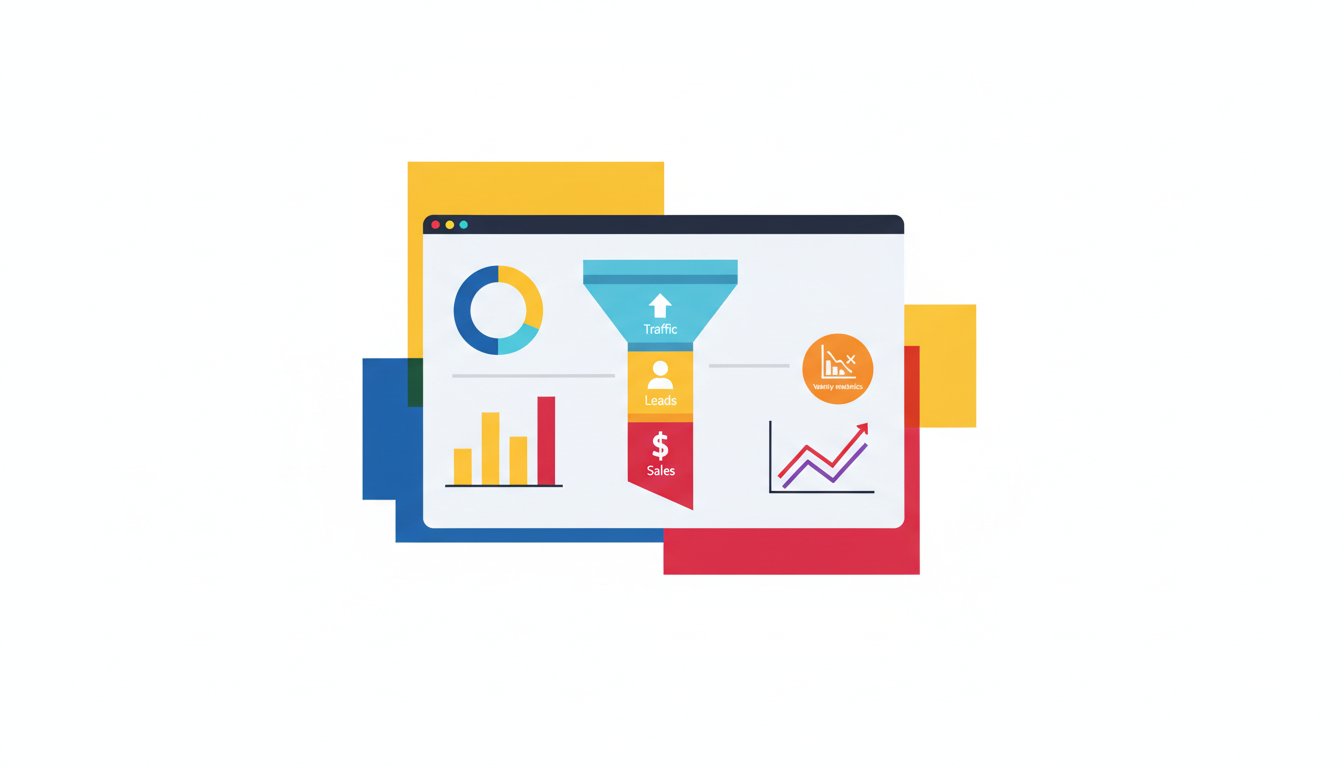
If you want this to stop being theory, your funnel needs to be mapped on a dashboard. If you can’t see it, you can’t improve it.
4) Measurement that doesn’t fall apart with iOS (Pixel + CAPI)
In Colombia, a large share of traffic comes from mobile. And on mobile, measurement breaks easily: iOS, ad blockers, cookies, browsers.
That’s why the minimum combination is:
- A properly installed Pixel
- Well-defined events
- CAPI (Conversions API) to recover signal
Without that, Meta optimizes on incomplete signal. And when Meta can’t see, it guesses.
5) Creatives: the angle sells, not the format
It isn’t “video vs. image”. It’s the angle.
Examples of angles that tend to work for leads:
- “You get leads, but none of them buy” (quality)
- “Your WhatsApp is full, but there’s no pipeline” (process)
- “Your team responds late and they slip away” (operations)
6) The point nobody wants to hear: sales is part of the funnel too
You can have the best campaign in the world… and lose it all if:
- you respond after 6 hours
- you don’t qualify
- you don’t follow up
- you don’t have a sales script

If you like, we’ll help you adjust the campaign and the process so leads turn into real opportunities. See our social media advertising (Meta Ads) service, or read our broader guide to Meta Ads for companies in Colombia.
Or if what you need is a complete system (measurement + campaign + landing page + follow-up), see lead generation.