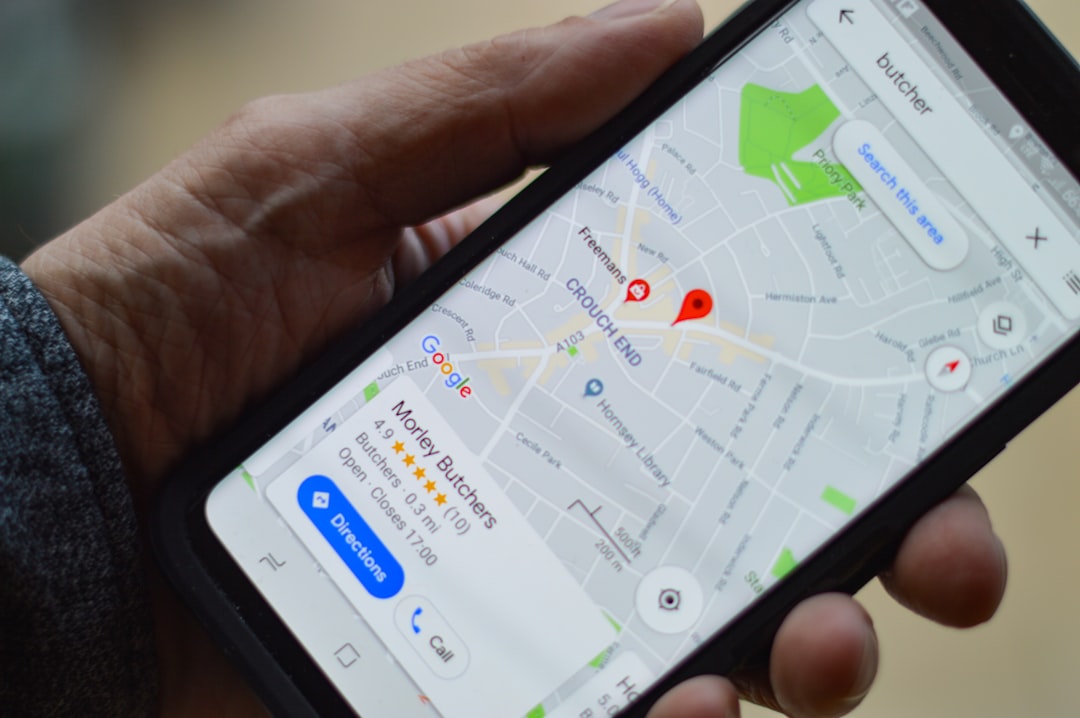
Your business shows up on Google Maps. The question is: are you making the most of that listing, or did you abandon it like a ghost profile?
Because if you have a Google Business Profile listing with no photos, no recent reviews and outdated information, it isn’t just failing to help you. It’s working against you. Every time a potential customer searches for your business and finds an empty listing, they come away with a worse impression than if they had found nothing at all.
46% of all Google searches have local intent. And 76% of people who search for something “near me” end up visiting a business within 24 hours. That isn’t theory. It’s real traffic heading to businesses that do have an optimized profile, while those that don’t simply disappear from the map.
In Colombia, where local commerce is still the engine of the economy, an optimized Google profile isn’t a branding luxury. It’s the difference between a customer finding you or passing you by because your competitor shows up first on the map.
And here’s the real problem: most Colombian business owners believe that having the profile created is enough. They don’t know that inactive profiles lose ground, that unanswered reviews count against them, and that a badly written address can make them disappear from the local map.
This isn’t just any directory
Google Business Profile (formerly Google My Business) is much more than a listing. It’s the main gateway for a potential customer to find you when they have purchase intent.
Think of it this way: when someone searches for “restaurant in Medellín” or “lawyer near me”, they aren’t browsing out of curiosity. They already have a need. And Google will show them three things: the map, three featured profiles and a list of local results. If your business isn’t in that top 3 on the map, you’re handing customers to your competitors.
The numbers don’t lie. Businesses with a complete, verified Google profile are 50% more likely to be considered by users. The difference between having up-to-date photos, reviews and hours versus a basic listing can mean half the leads you’re losing without knowing it.
If your profile isn’t optimized, every day that goes by you’re losing customers who are searching for exactly what you sell.
Optimization checklist: what your profile needs RIGHT NOW
You don’t need to be an SEO expert to have a flawless profile. But you do need to follow a concrete list. This is what Google evaluates to decide whether your profile deserves to be in the top 3 of the local map or ends up buried on page 2.
Claim and verify your profile
It sounds obvious, but in Colombia there are thousands of businesses with unclaimed profiles. Google creates them automatically using data from public directories, and if you don’t claim them, anyone can suggest edits, including changes that damage your reputation or redirect people to your competitors.
Try it: search for your business on Google Maps and see whether the message “Own this business?” appears. If it does, other people can suggest edits without you having any control over what gets published.
The verification process is simple, but in Colombia it has its particularities. Go to google.com/business, find your business and request verification. Depending on the case, Google may ask you to verify by video, phone, email or postcard (the slowest option, which can take 5 to 14 business days). If you chose a postcard and it hasn’t arrived within two weeks, request another one from the dashboard. Don’t let more than 30 days go by, because Google may invalidate the request.
NAP consistency: the most expensive mistake
NAP stands for name, address, phone. And the rule is simple: it must be exactly the same everywhere. On your Google profile, on your website, on your social media and in the directories where you appear.
If your website says “Calle 10 # 20-30, Oficina 204” and on Google Maps you write “Cra 10 Nro 20-30 Of 204”, Google can’t be sure it’s the same business. And when it’s in doubt, it doesn’t show your profile.
In Colombia this is especially critical because we use multiple address formats: “Cra”, “Carrera”, “Calle”, “Cl”. If you mix abbreviations across platforms, you’re confusing the algorithm. The recommendation: define a standard address format and use it identically on your website, your Google profile, your social media, business directories, the yellow pages and any platform where your business appears.
Inconsistent NAP is the #1 reason legitimate profiles don’t show up in local searches.
Category: the #1 ranking factor
The primary category you choose carries the most weight in Google’s local search algorithm. It isn’t a minor detail. It’s the variable that most influences whether or not you appear for a specific search.
If you have a restaurant, don’t choose “Local business”. Choose “Colombian restaurant”, or “Fast food restaurant”. Be specific. And use all the secondary categories available that apply to your business. Each additional one tells Google which terms you want to appear for.
Photos: 20+ and up to date
Profiles with more than 20 photos receive more than twice as many direction requests as profiles with fewer than 10. Photos aren’t decoration. They’re visual social proof.
Forget generic stock photos. Customers want to see your real premises, your team, your storefront and your products. So does Google: it values original photos and customer photos over generic images.
Take good-quality photos with your phone. Show the exterior (so people can find you), the interior, the team at work and your star products. Update them at least once a month. A profile with fresh photos tells Google the business is active.
Hours and attributes
It seems unbelievable, but a huge percentage of profiles in Colombia have outdated hours. If your profile says you open at 8 a.m. but you actually open at 9, you’re creating a bad experience before the customer even arrives.
Update your regular hours and special hours (public holidays, seasons), and use attributes: “Has Wi-Fi”, “Accepts cards”, “Parking”, “Wheelchair accessible”. Every attribute is one more reason for a customer to choose you over the competition.
Is your profile optimized up to this point? If you haven’t checked it in the last 30 days, it probably has at least three errors.
Reviews: the engine of local reputation
If there’s one thing that determines whether a customer chooses your business or a competitor’s, it’s reviews.
97% of consumers read reviews before deciding. And 47% say they wouldn’t consider a business with fewer than 20 reviews. Twenty. That means if you have 3 reviews, for almost half your prospects you simply don’t exist as a serious option.
In industries like restaurants, dental clinics, auto repair shops or professional services in Colombia, the number of reviews is often the deciding factor. Two businesses with the same 4.5-star rating: the one with 30 reviews beats the one with 8, even though they have the same score. Volume is a signal of legitimacy.
How to ask for reviews (without being annoying or breaking policies)
The ideal moment to ask for a review is immediately after a successful purchase or service. Don’t wait for days. The customer is satisfied and has just had a positive experience. That’s your golden moment.
Create a direct link to your review profile. Go to your Google Business Profile dashboard, find the reviews section and generate a short link.
The weekly process I recommend:
- Immediately after the sale: send the link via WhatsApp with a simple message.
- A QR code on the premises: place a QR code at the checkout.
- A post-sale email: automate an email 24 hours after the purchase.
- On digital invoices: include the link at the end.
Important: Google explicitly prohibits paying for reviews or offering discounts in exchange for them. Don’t do it. But you can remind customers how valuable their opinion is for helping others.
A business that implements a systematic process can go from 5 to 30 reviews in less than three months.
How to reply to reviews (this matters more than you think)
89% of consumers expect businesses to respond to reviews.
Template for positive reviews: “Hi [name], thank you so much for your review. We’re very glad you enjoyed [specific mention of the product/service]. We look forward to seeing you again soon.”
Template for negative reviews: “Hi [name], thank you for your honesty. We’re sorry your experience wasn’t the best. We’d like to resolve this directly. Please write to us at [WhatsApp/email] so we can better understand what happened.”
A fact many people ignore: a negative review with a professional, solution-oriented reply generates more trust than a profile with only perfect reviews.
How often you reply matters for the algorithm. Block out 15 minutes every Friday to reply to all of the week’s reviews.
How your profile affects local SEO
Google uses a set of factors to determine which businesses to show in local results. Understanding them gives you an advantage over the 80% of Colombian businesses that simply have the profile created and never touch it again.
Factor #1: Business category
It’s the single most important factor. Make the most of secondary categories (up to 10).
Factor #2: Keywords in the profile name
Keyword stuffing in the business name is a direct violation of Google’s policies and can result in the profile being suspended without warning.
In Colombia there have been waves of suspensions for this practice. Recovering a suspended profile requires sending legal documents to Google, and the process can take weeks. It isn’t worth it.
Factor #3: Proximity
This is the factor you have the least control over: the user’s location relative to your business. But you can influence it in two ways: an exact pin on the map and precise addresses with nearby landmarks.
Factor #4: Reviews (quantity, frequency and quality)
It isn’t just how many reviews you have, but how often they come in. A business that receives reviews every week beats one that received 50 reviews two years ago and none since.
Factor #5: Behavioral signals
Direction requests, calls from the profile, clicks to the website. Google measures how many people interact with your profile.
Factor #6: Website signals
Your website and your Google profile aren’t separate planets. Google cross-checks the information. If your website has NAP consistent with the profile, is mobile-optimized, loads fast and has relevant local content, it reinforces the authority of your local profile.
At Gulupa Digital we work with clients such as the Jardín Botánico de Medellín and the Archdiocese of Medellín on the joint optimization of their website and Google profile.
The 10 most common mistakes in Colombia (and how to fix them)
I’ve reviewed dozens of Colombian companies’ profiles. For an official reference, Google publishes regular guidance on how to optimize your business profile:
- An unclaimed profile. The mother of all mistakes. Google creates the listing automatically. If you don’t claim it, anyone can edit it.
- An incorrect or vague address. Very common in Medellín: writing only “El Poblado” without the exact address.
- Stock photos. They add no real value, and a real photo taken with a phone is more effective.
- Keyword stuffing in the name. The most dangerous mistake. Google has suspended profiles in Colombia for this.
- The wrong category. A dental clinic that chooses “Local business” loses every specific search.
- No Google Posts. Posting weekly is a signal of activity that Google values.
- Unanswered reviews. 89% of consumers expect a reply.
- Outdated hours. Especially on public holidays and during vacation seasons.
- Missing attributes. Small details that tip the customer’s decision.
- Not using Q&A. An open section you need to manage to prevent incorrect information.
Fix these 10 mistakes today and your profile will be better than most of your local competitors’.
Google Posts, Q&A and products: what nobody uses (and why it works)
There are three Google Business Profile features that most companies in Colombia ignore completely. And they’re exactly the ones that can give you an immediate competitive advantage.
Google Posts: your weekly voice on the map
They’re like social media posts, but they live inside your Google profile. Post at least once a week. They don’t have Instagram’s reach, but they have something more valuable: high purchase intent.
Questions and answers (Q&A): preventive intelligence
The Q&A section is open for any user to ask questions. Get ahead of it. Prepare a list of the 10 questions your customers ask you most often. Google indexes these questions and answers.
Products and services: your shop window on the map
Add up to 200 products with a photo, price and description. In businesses such as restaurants, aesthetic clinics, repair shops or clothing stores, Google shows these products directly in local search results.
Frequently asked questions
How long does Google take to verify a profile in Colombia?
It depends on the method Google asks for. Video, phone or email verification can be resolved within days; a postcard can take between 5 and 14 business days. If the code doesn’t arrive within that period, request another one from the dashboard.
Can I have more than one profile for the same company?
Yes, as long as you have multiple real physical locations that serve the public. Each branch must have its own profile with a unique address and phone number.
Can keyword stuffing in the name really get my profile suspended?
Yes. Google has suspended profiles in Colombia for including extra keywords in the business name. A suspension means your profile is no longer publicly visible.
What should I do if someone leaves a fake review on my profile?
Report the review from the Google Business Profile dashboard as a “conflict of interest” or “fake content”. While it’s being resolved, reply professionally.
Do stock photos really affect my profile’s performance?
Yes. Google prefers original photos that faithfully represent the business. Generic stock photos add no real value.
Your Google profile is your first digital impression
When someone searches for your business, the first thing they see isn’t your website. It’s your Google Business Profile listing: that card with stars, photos and hours that appears on the map. That’s your first impression, and you only get one chance to make it.
If it’s incomplete, outdated or full of errors, you’re communicating neglect before the potential customer even talks to you. If it’s optimized, with recent reviews, real photos and accurate information, you’re building trust from the very first click.
The difference between the two scenarios isn’t a matter of luck. It’s a matter of execution. And as you’ve seen, most of the fixes are things you can do today without spending a peso.
That’s exactly what we do at Gulupa Digital. We don’t offer to “fill in your profile”. We offer a complete local presence strategy that connects your Google profile, your website, your content and your online reputation in a single system designed to attract customers who are already searching for what you sell.
Book a free audit of your local presence and discover exactly which opportunities you’re missing. It isn’t a sales call. It’s a 20-minute diagnosis in which we review your profile, your website and your competition.